
ESSAY
CRAFT IN MOTION
For tradition to live on, everything must move
and be allowed to.


SUMMARY
Craft in Motion is a photographic series by NgheNghe Studio, born from an encounter with handcrafted objects at Bách Tác.
The project approaches local craft not as a heritage frozen in the past, but as a living body of knowledge- continually adapted and remade across generations.
By placing these objects within new worlds, functions and contexts, the series imagines the other lives they might come to inhabit.
For tradition to live on,
sometimes everything must be allowed to move.


AN OFFLINE ENCOUNTER
*The idea for Craft in Motion did not begin with a grand theory of heritage.
It all began with an offline encounter in Ho Chi Minh City, on an ordinary day in 2026.
The first time we stepped into Bách Tác, we were delighted to discover objects shaped by techniques passed down through generations. Contrary to familiar perceptions of traditional craft, these objects were not fixed in the past. They carried a distinctly contemporary pulse.
The techniques remained, while the forms had shifted.
The materials felt familiar, while their functions had evolved to suit new ways of living.
Long values endured, though they were still-somewhat tentatively-finding their way into a new life.
From this observation, a question gradually emerged among the creative practitioners at NgheNghe:
How can craft continue to evolve without losing what made it what it is?


TRADITION NEVER STANDS STILL
We often think of tradition - or, more specifically, local craft - as an original form that must be preserved.
Yet no tradition has ever been passed down by remaining entirely still and unchanged.
With each generation, craft is selected, adapted, reinterpreted and remade in response to new ways of living and changing contexts.
Its continuity therefore depends not only on preserving what already exists, but also on the ability to create forms that have never existed before.

LOCAL CRAFT IS A BODY OF KNOWLEDGE
Here, “the local” is not understood as a colour palette, a pattern or a fixed aesthetic that can be easily recognised.
The local is a body of knowledge shaped in place, through enduring relationships between people, materials, terrain, climate, customs and collective memory. It lives in the craftsperson’s understanding of the tension of paper, the moisture of clay, the heat of fire, the strength of metal, and the grain a piece of wood retains after weathering rain and flood.
Craft, therefore, is more than a type of product.
It is a way of knowing - a way of understanding.


WORKING WITH MATERIALS
This knowledge cannot be fully contained in a formula, nor can it be passed on through words alone.
It accumulates through gesture, sensation, repetition, trial and error, and the ability to respond to material.
Craft practitioners do not simply impose a predetermined form upon matter. They work with it, listening to what it permits, resists or unexpectedly reveals.
The finished work is therefore the outcome of a negotiation between human intention and the material’s own life.

POSSIBLE LIVES
Building on this foundation, Craft in Motion takes the form of a photographic series that moves beyond the idea of
“modernizing craft” by simply giving it a new look.
The project does not see the new as a replacement for the old, either.
What interests NgheNghe is "the moment of transition" between two states: when an object begins to move beyond familiar patterns while carrying the memory of where it came from.
In this photographic series, lacquer steps off the flat surface to become a character. Dó paper becomes more than a surface for images and writing, taking shape as structure, light and space. Trúc Chỉ takes the stage as a relatively young practice among local craft traditions, expanding our understanding of tradition itself.
Bình Dương ceramics inhabit multiple eras at once. Pháp Lam journeys through traces of history to be reborn in new forms. Củi Lũ transforms the scars of natural disasters into a visual language. Incense moves from the space of communal ritual into the inner world of the individual.
These objects no longer appear as products waiting to be described.
They become subjects with pasts, presents and possible futures.

PHOTOGRAPHY AS A MEDIUM FOR REFLECTION
Here, photography does more than document.
It becomes a medium for reflection, a space of possibility in which NgheNghe asks:
What else might a handcrafted object become?
Through world building, light, movement and shifts in context, each work draws objects out of their familiar uses,
revealing possibilities already held within them.
Movement in this series sometimes takes the form of a departure from orbit,
a broken frame, or an object lifted from a seemingly secure base.
But sometimes, movement is simply a small shift in how we see.
A product enters a different space.
A material takes on another function.
An old technique meets a new need.
These small shifts shape the social lives of objects, where their value continues
to emerge through the ways people use, exchange, display and imagine them.


TRADITION IN THE PRESENT TENSE
Printed on paper and displayed among the handcrafted objects at
The Artisans Fair 4, the photographic series opens up two parallel ways of seeing.
On one side are the objects as they are.
On the other, the lives they might come to inhabit.
The space between them opens up possibilities for imagining craft’s future while keeping it connected to its origins.
Craft in Motion therefore seeks no definitive answer to what Vietnamese craft should become. It simply proposes a way of seeing: rather than treating tradition as a finished image, consider it a practice still unfolding.
For tradition does not stay alive by forever resembling its past.

Tradition lives on because each generation still wants to touch it, engage with it, and set it in motion once more.

END OF ESSAY

ARTWORK DESCRIPTIONS
01. LAM PHONG LACQUER
Breaking Out of Orbit
Looking at the characters in Lam Phong’s lacquer works, NgheNghe sees a small world with cycles of its own. These figures seem settled within a familiar order, yet carry a playful, lively and slightly mischievous energy.
In this work, that order is suddenly thrown off balance. The characters are “flung” out of their old orbits, leaving the base that once supported them to enter a new state of motion.
This departure is no accident. It is a necessary moment for a longstanding practice to discover another possibility for growth.

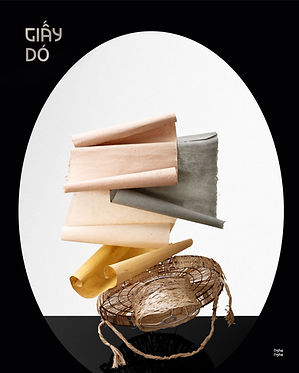
02. DÓ PAPER
Transforming Form
Dó paper is often thought of as a flat surface for writing, drawing or preserving memories. But at Bách Tác, NgheNghe encounters the material in other forms: curved, sculpted, filtering light and helping shape space.
From this encounter, the work imagines dó paper being lifted from its familiar base by an invisible force. The material leaves its settled state and enters a process of transformation.
A lamp, a hat or a new sculptural form are not separate identities, but possibilities that have always coexisted within this age-old material.
03. LACQUER ANIMALS
When the Frame Is No Longer Wide Enough
Lacquer was once closely associated with the flat surface of a painting. With the arrival of lacquer animals, however, the material seems to have “grown legs,” becoming a character and stepping beyond the frame that once defined it.
NgheNghe draws on the game of blind man’s buff to explore the uncertainty of transformation. One animal is blindfolded; the others run, hide and seek new positions. They have left their old world behind, without knowing exactly where they are headed.
The work focuses less on disorientation than on the necessary interval of transition before a new form can be named.

04. TRÚC CHỈ
A Newcomer Full of Possibilities
Compared with many longstanding craft practices, Trúc Chỉ is a young innovation. This youth leads NgheNghe to see it as a “newcomer”: entering the field with less history, yet carrying possibilities still waiting to be defined.
The work creates a stage for its debut, where Trúc Chỉ steps into the light and finds its own place. Layers of fibre, patterns, light and shadow become its language of performance.
This “newcomer” belongs within tradition. It reveals how Vietnamese tradition continues to be invented through local materials and knowledge.

05. BÌNH DƯƠNG CERAMICS
Parallel Worlds
Looking at Bình Dương ceramics, NgheNghe sees no absolute boundary between old and new. Familiar techniques, forms and functions endure, providing the foundation from which new forms continue to emerge.
The work imagines two lives of ceramics coexisting within one world. One preserves what has already taken shape; the other reaches upward, expands and seeks new ways of being present.
The new neither rejects nor replaces the old. They grow alongside one another, like branches sharing the same roots.

06. PHÁP LAM
Rebirth Among the Remnants
Pháp Lam once adorned imperial buildings and court objects before falling into decline amid historical upheaval. Its return brings more than the restoration of lost forms: the craft enters everyday life through animal figures, utensils and other familiar objects.
NgheNghe places Pháp Lam in a world marked by ash, broken bricks and metal. From these remnants, the enamel’s colours begin to glow. Smoke and fire evoke destruction while recalling the very firing process that gives Pháp Lam its form.
A craft survives not simply by overcoming its past, but by drawing on that past as material for its rebirth.

07. CỦI LŨ
From What Was Swept Away, a New Life Begins
Củi Lũ takes shape from pieces of wood left behind after the flood season in Quảng Nam. Swept away, trapped and seemingly reduced to the remnants of a natural disaster, they are gathered, carved and given new form.
Through NgheNghe’s eyes, Củi Lũ returns with more than a story of sorrow. The animal appears amid water, broken tree trunks and an unfinished landscape, a creature born from the very force that once wounded it.
The scars remain visible. They become the contours of the work, where memories of loss are transformed into a language of vitality.

08. SCULPTURAL INCENSE
Scent: A Bridge to Our Inner Worlds
Incense is often associated with worship, ritual and solemn spaces. But shaped into small, familiar and visually expressive objects, it begins to enter another kind of life: more personal, more everyday and closer to the sensibilities of a new generation.
Scent is invisible, yet it can awaken memories, shift moods and draw us inward. From this paradox, NgheNghe imagines each vessel as an inner world.
Incense becomes a bridge between the visible and the invisible, between the object outside us and the quiet movements unfolding within.

About NgheNghe
Studio
NgheNghe is an editorial-first creative studio from Vietnam, where creativity begins with human connection. Across three areas of practice - NgheNghe Lab, NgheNghe Commercial and NgheNghe Connect - we bring together creative strategy and direction, stories that move people, and an experimental approach to execution. With the ambition to sustain our creative practice for over 100 years, we continue to create, develop knowledge and build community, pursuing work that is worthwhile for ourselves, our clients and the wider public.
About
The Artisans Fair
The Artisans Fair is an annual event initiated by Bách Tác Space, showcasing handcrafted objects and the stories of Vietnamese materials, techniques and culture behind them. For its fourth edition, the fair is presented in collaboration with Takashimaya Vietnam as part of its ESG programme, bringing Vietnamese craft closer to contemporary life and opening up new connections between makers, their work and the public.
The Artisans Fair 4
18-27 September 2026
Event Hall, Level 3, Takashimaya
92-94 Nam Kỳ Khởi Nghĩa Street, Sài Gòn Ward, Ho Chi Minh City
About 100 VIETNAMESE STORIES
100 Vietnamese Stories is a long-term visual practice by NgheNghe Studio exploring Vietnamese memory in motion. With photography as its primary medium, the project seeks out familiar memories, symbols, materials and sensibilities, reimagining them through contemporary perspectives and creative experimentation.
Part of this ongoing project, Craft in Motion is a photographic series created by NgheNghe in collaboration with Bách Tác Space. It explores how longstanding craft traditions continue to evolve, regenerate and find new life in the present.

INTRODUCTION
CREDITS

By NgheNghe Studio
(Khoachim, Hoàng Giang, Tuấn Lực, Mẫn Thư, Phương Quỳnh, Thiên Kim)
Bộ hình có sự đồng hành nhiệt thành từ @bachtac.space
Creative Direction: @Khoachim
Creative Team: @tlu.ntr, @min_j.i_e, @kisnana, @throughgiang, @nghequynhnghe
Photographer: @throughgiang
Photographer Assistants: @tlu.ntr, @min_j.i_e, @kisnana
Producer: @nghequynhnghe
Props by: @kisnana @min_j.i_e @throughgiang @tlu.ntr @nghequynhnghe
Styling & set design: @tlu.ntr @throughgiang @min_j.i_e @kisnana
Retoucher: @throughgiang @tlu.ntr @min_j.i_e
Graphic designer: @min_j.i_e @khoachim
Copywriter: @nghequynhnghe @khoachim
Essay: @khoachim